The Three Goals on Every Fleet Manager's Whiteboard This Year — and the Tech That Actually Moves Them
Roughly 900 fleet professionals say the same three things dominate their 2026 priorities. Here's where the technology has finally caught up with the goals.
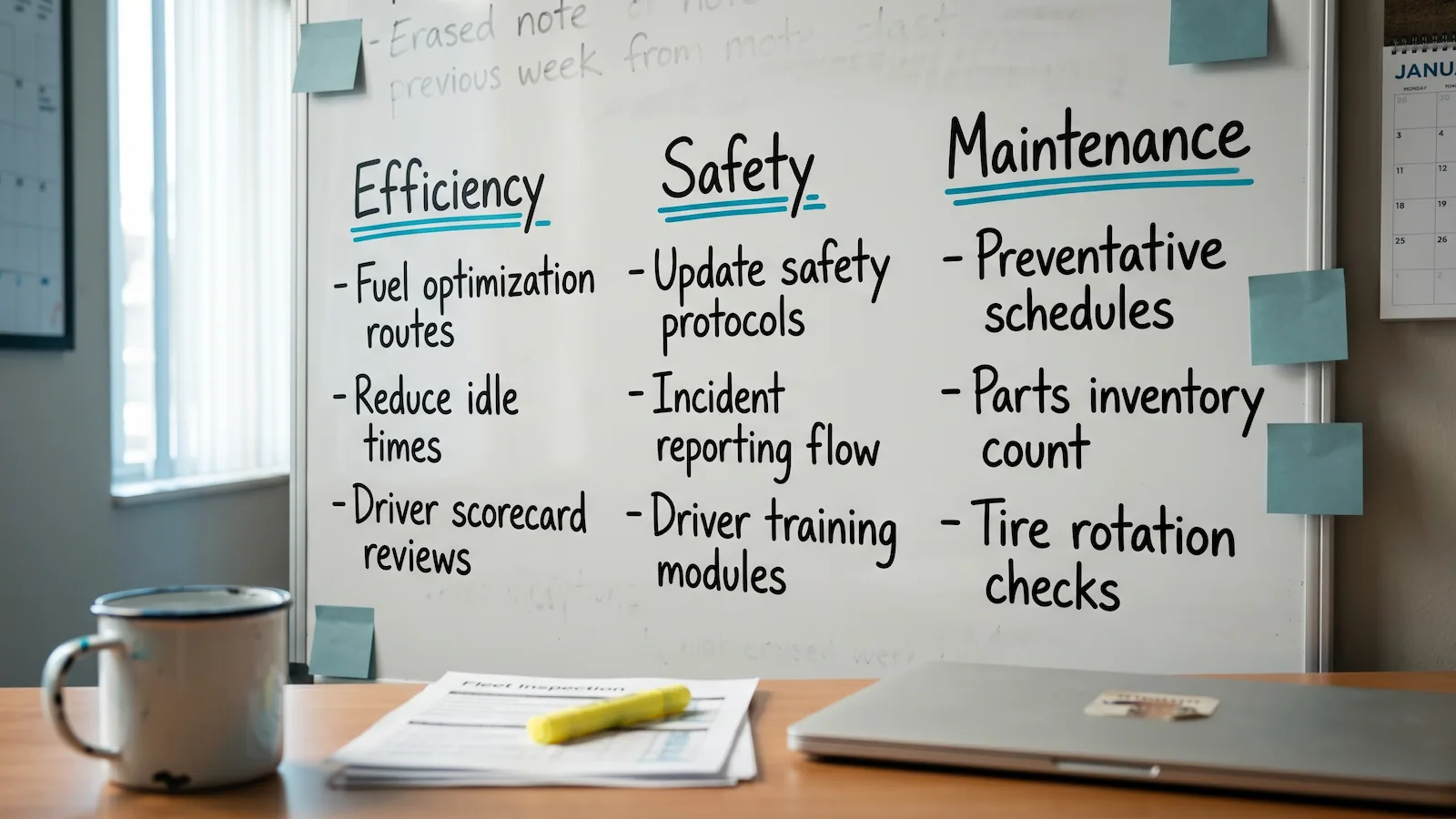
Key takeaways
- A survey of roughly 900 fleet professionals points to the same three 2026 priorities: efficiency and productivity, safety, and maintenance optimization.
- Efficiency is the biggest bucket (about two-thirds name it primary); fleets using connected telematics report 11–19% gains across fuel, accidents, labor, and maintenance.
- Safety has surged — video telematics adoption is around 46% (up about ten points) — driven by insurance credits and in-cab AI coaching that cuts harsh events within 90 days.
- Maintenance is shifting from reactive to predictive: real-time engine fault codes, usage-based PM scheduling, centralized records, and per-asset cost visibility.
- One thread ties all three together: data integration. The fleets seeing the biggest returns connect their data across systems instead of leaving it siloed.
The three goals
Walk into the office of almost any fleet manager planning their 2026 budget and you'll see three priorities scribbled somewhere — on a whiteboard, in a strategy doc, in the talking points for next month's leadership review. They've been the priorities for years. What's new in 2026 is that the technology to actually move them has caught up, and the fleets willing to put the work in are seeing measurable returns.
Drawing on the latest industry research — including a recent annual survey of around 900 fleet professionals across government, commercial, and enterprise operations — three goals dominate the conversation. Here's what they are, what's actually changing, and where the leverage points sit this year.
Goal one: efficiency and productivity
The largest single bucket. Roughly two-thirds of fleet leaders name efficiency and productivity as their primary focus over the next twelve to eighteen months. The reason is straightforward — operating costs keep rising, and adding more trucks or more drivers isn't always an option. The only path to better numbers is squeezing more output out of the assets and people you already have.
The interesting part of the 2026 data is that the fleets actively using telematics and connected data to drive operational decisions are reporting average gains of 11 to 19 percent across fuel, accident, labor, and maintenance line items. That's not marginal. Compounded across a fleet of any size, it's the difference between a tough year and a strong one.
The tactics that are showing up most often:
Real-time route optimization
Static routes built once a year and never revisited are giving way to dynamic routing that incorporates live traffic, weather, and customer time windows. Fleets that adopt it well are seeing fewer miles per stop and tighter on-time performance.
Asset utilization tracking
A surprising amount of fleet capacity is wasted on vehicles that simply don't move enough. Connected data makes it visible. Once you can see that ten units are moving below 40% utilization, the conversation about right-sizing the fleet becomes much sharper.
Idle reduction
Still one of the largest hidden levers. Idle time burns fuel, racks up engine hours, and contributes to maintenance cycles, yet most fleets only measure it after the fact. Real-time idle alerts and driver coaching change that loop.
Goal two: safety
Adoption of video telematics is now around 46% of fleet professionals — a ten-point jump in just the last few years. Safety has quietly displaced fuel savings as the most-cited reason fleets invest in connected technology, and there are good reasons for it.
First, the insurance math has shifted. Carriers are now offering meaningful premium credits to fleets that can demonstrate active driver-coaching programs backed by video evidence. Those credits often offset the cost of the program in year one.
Second, AI-enabled dash cams have moved from "expensive experiment" to "operational standard." Edge processing means events get flagged and clipped automatically — no more managers spending hours scrubbing footage looking for the moment that matters.
Third, in-cab coaching alerts work. Drivers respond to immediate, in-the-moment audio cues in a way they never responded to a coaching session three days after a behavior occurred. Most fleets running these systems see meaningful drops in harsh-event frequency within the first 90 days.
The fleets winning at safety in 2026 aren't necessarily the ones with the fanciest hardware. They're the ones who paired the technology with a real coaching cadence — weekly reviews, recognition for top-performing drivers, and managers who treat the dashboard as a starting point for conversations rather than a scorecard.
Goal three: maintenance optimization
The shift from reactive repair to predictive and preventive maintenance is finally hitting mainstream. The fleets that are doing it well are seeing the kinds of downtime reductions and asset-life extensions that actually move the P&L.
What's enabling it:
Engine fault code monitoring in real time
A check-engine light used to mean "a driver might tell you about it tomorrow." Modern telematics surface fault codes the moment they happen, with severity context, so the shop can decide whether to route the vehicle in immediately or schedule it for the next available bay.
Mileage and engine-hour-based PM scheduling
PMs that fire automatically based on actual usage rather than manual calendar entries virtually eliminate the "we forgot" failure mode that drives so many missed services.
Centralized maintenance records
Fleets running across multiple shops or regions historically had record-keeping fragmented across vendor portals, paper files, and shop-specific systems. A centralized record makes warranty recovery, recall management, and total-cost-of-ownership analysis dramatically easier.
Per-asset cost visibility
When you can see exactly what every vehicle costs you per mile, replacement and reassignment decisions stop being guesswork. The bottom 10% of any fleet on cost-per-mile usually pays back any analysis effort many times over.
The thread that ties all three together
Look closely at the three goals and the same theme runs through all of them: data integration.
Efficiency gains depend on telematics data flowing into dispatch decisions. Safety gains depend on video data flowing into coaching workflows. Maintenance gains depend on telematics data flowing into the shop's work-order system. None of these capabilities work in isolation, and the fleets seeing the largest returns are not the ones collecting the most data — they're the ones whose data flows are connected across systems instead of stranded in silos.
If you're planning your 2026 fleet technology investment right now, that's the question to ask before any feature comparison: does this connect cleanly to what we already run, or are we adding another island? The fleets that pick integrated capabilities and actually operate them get the gains. The fleets that buy point solutions and let them sit unused get the invoices. In a year where every basis point of margin matters, that distinction is the difference. For a side-by-side look at how the major fleet platforms stack up, our fleet management software comparison walks through FS365 vs. Fleetio, Samsara, Geotab, and Verizon Connect on integration depth.
Start a free 14-day trial. No credit card, no usage caps.
Start free trial →